The 3pm Top-Up: Reapplying SPF Over Makeup in a British Working Day
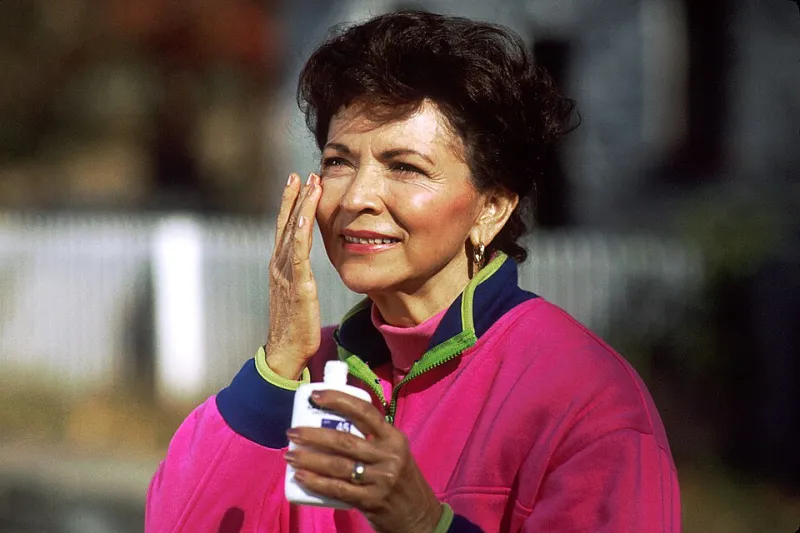
Photo: Bill Branson (photographer), Public domain, via Wikimedia Commons
The British relationship with sunscreen is seasonal in a way the science is not. The Met Office UV index may only nudge into the moderate band between April and September, but UVA — the wavelength responsible for pigmentation, photoageing and much of the damage done through glass — stays broadly constant across the year. Cloud reduces UVB sharply. It reduces UVA far less.
For anyone wearing makeup on a working day, the practical question is not whether to reapply but how to do so without dismantling a finished face at 3pm. Answering it well requires a format comparison, a patch test, and a short routine that takes less than three minutes.
Why the Morning Layer Is Not Enough
The reason is film integrity, not chemical decay. Modern filters are photostable enough that degradation is a secondary concern. What fails first is the continuous film: sebum production, transfer onto a phone or scarf, blotting, and the ordinary friction of a day all thin it unevenly. The result is patchy coverage — typically intact across the forehead, compromised around the nose and chin, which are also the areas most exposed.
The common assumption that two hours indoors resets the clock is worth correcting. The two-hour interval applies to direct exposure. A commute on an overheated Northern line followed by a walk along a sunlit street counts; an afternoon at a desk three metres from an unshaded window counts for less, but does not count for nothing, because standard glazing blocks UVB and transmits a significant proportion of UVA.
Comparing the Formats
| Format | Best used for | Coverage reliability | Finish | Caveats |
|---|---|---|---|---|
| Stick | Nose, cheeks, brow bone, ears | Medium to high on targeted areas | Satin to balmy | Dragging can lift base; needs four passes to reach stated protection |
| Powder | Shine control and mattifying touch-ups | Low to medium | Matte | Difficult to apply enough for full SPF without a chalky result |
| Mist | Fast coverage over a large area | Low to medium | Variable, often dewy | Uneven deposition; requires eyes closed and multiple passes; inhalable |
| Cushion compact | Mid-day on the move | Medium | Natural to luminous | Hygiene concerns; sponge needs regular washing |
| Emulsion on a damp sponge | Highest reliability over makeup | High | Adaptable | Slower; best suited to a full reset rather than a top-up |
No format here replaces a proper morning application of a dedicated facial SPF, and powders in particular should be regarded as a supplement rather than a primary layer. Their real value is cosmetic: they let a reapplication happen at all, which is more than most people manage otherwise.
Patch-Testing Without Spoiling a Working Day
Sprays and powders introduce two avoidable risks: fragrance and propellant delivery. Test on the jawline or behind the ear on a normal working day rather than the morning of an event, and allow 48 hours. If you have rosacea, a history of perioral dermatitis or a fragrance sensitivity, choose a stick or a fragrance-free cushion formula over an aerosol mist. When using a spray near the face, close the eyes fully, hold the can at least 15cm away, and apply in a well-ventilated space — never in a cramped train carriage.
The Three-Step Playbook
Step one: blot, do not rub. Press a blotting sheet over the T-zone and any areas where base has separated. Rubbing redistributes pigment and disturbs the film you are about to rebuild. Give it thirty seconds to settle.
Step two: rebuild in zones. Use a stick in short, patting strokes across the high points — nose bridge, cheekbones, forehead centre, chin — then blend the edges with a fingertip or a damp makeup sponge so the product sits on top of the base rather than dragging through it. For the rest of the face, a cushion compact or a fine mist applied in overlapping passes will restore a workable layer.
Step three: set and go. A light dusting of translucent powder over the stick-treated areas prevents migration and restores a matte finish in the places that need it. Avoid powdering the cheeks if the goal is a dewy finish; concentrate on the T-zone.
Timing Triggers Worth Diarising
The routine works best when attached to fixed moments rather than a clock. Reapply before leaving the office for a lunchtime walk. Reapply before the return commute between May and August, when the afternoon UV peak coincides with the journey home. Reapply after any gym session or extended period outdoors, regardless of the month. On a clear February afternoon, a twenty-minute walk will not burn British skin — but it will contribute to the cumulative UVA load that shows up a decade later.
Inside a fully indoor working day in December, a single well-applied morning layer is defensible. The failure mode to avoid is the eight-hour summer Saturday, one morning application, and an evening spent wondering why the cheeks are flushed.
Building the Commuter Kit
Keep it small enough to live in a handbag and specific enough to be used. Blotting papers; one SPF 50 stick for high-point touch-ups; either a compact cushion or a 50ml mist — not both; a small damp sponge in a case if the finish matters; and a translucent powder only if shine is the actual complaint. Replace the stick at the end of its stated period after opening, and wash any sponge weekly.
The Precision Position
Reapplication over makeup is a compromise, and it is worth being honest about that. It will rarely deliver the full stated SPF across every square centimetre. What it does deliver is continuity — an unbroken, if uneven, layer rather than a morning film that has quietly thinned since 8am. For a British commuter, that continuity, performed reliably, is worth more than a perfect application performed once.